
We run our water system under an “Approval to Operate,” as issued by Alberta Environment. The province requires us to have our water tested at least twice per year by a provincially-approved lab.
Water Quality
We are committed to the protection of public health and safety by ensuring that the water leaving the Water Treatment Plant exceeds the Canadian Drinking Water Standards.
Every month we take at least one bacteriological sample per 1,000 people (or at least 20 samples per month) from a variety of locations within Camrose. The Provincial Health Lab analyzes the samples and then submit reports to the Local Health Authority and the City of Camrose.
The results from all water quality testing is public information. We submit these results daily to Alberta Environment. You can get the water quality testing data from Public Works by calling 780.672.5513. This information is also on Alberta Environment's Camrose Waterworks System monitoring website.
Lead in Water
In 2019, Health Canada lowered its guideline for lead in drinking water from 0.010 mg/L to 0.005 mg/L. This guideline is measured at the tap, rather than within the water distribution system.
Since that time, the City of Camrose has been taking steps to better understand and reduce the risk of lead in drinking water. Early work included reviewing historical records, identifying properties that may have lead service lines, and completing required water sampling to understand potential exposure at the tap.
In 2021, the City completed random water testing across the community and continued work to confirm the location of any lead service lines. This information helped guide the development of a long-term approach to managing lead.
In March 2026, City Council approved a Lead Management Policy to guide the City’s next steps. The City is now moving into implementation, which includes targeted testing, ongoing investigation, direct communication with affected properties, and a new program to provide certified water filter pitchers to eligible households.
The water leaving the City of Camrose Water Treatment Plant has very low lead levels, typically around 0.0001 mg/L, which is well below Health Canada’s maximum acceptable concentration. The City’s watermain distribution system does not contain lead pipes. However, lead can still enter drinking water through older plumbing materials in some homes.
This page will continue to be updated as more information becomes available.
Frequently Asked Questions
Lead is a naturally occurring element that is found in small amounts on the earth’s outer layer. Lead has a high resistance to corrosion and is very malleable, for this reason it has historically been used for lead service pipes. This is because during times of war, copper wasn’t a common material for plumbing and therefore, lead was used.
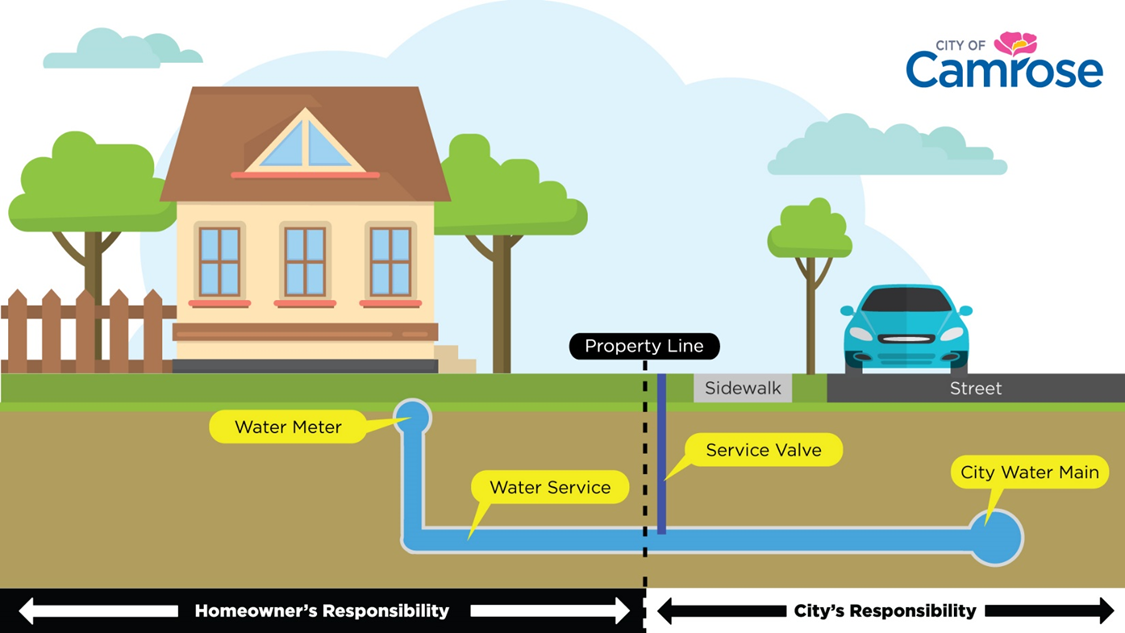
Lead service lines (LSLs) are water service pipes made out of lead that connect the City’s watermain to your home. Since 1960, LSLs haven’t been a common material used for pipes but were prohibited in 1975 by the National Plumbing Code. In 1986, the National Plumbing Code then prohibited the use of lead plumbing materials such as lead solder and brass fittings.
The water leaving the City’s water treatment plant are typically 0.0001 mg/L or less. This is 50 times lower than Health Canada’s new maximum acceptance concentration for lead. Camrose meets or exceeds all of the federal and provincial standards.
The City of Camrose does not have any lead pipes within the City’s water main distribution system. However, lead may still be introduced through household plumbing material if they are lead pipes, lead solder, or brass fittings.
How can lead affect my health?
Pregnant women and children under the age of six are more vulnerable to lead. Pregnant woman who have been exposed to lead can expose their baby to lead during pregnancy or through breast feeding. Young children who are exposed to lead can cause adverse effects on neurological development and behavior. It is recommended that pregnant women and young children have no exposure to lead and reduction can be found below.
In adults, prolonged lead exposure can cause increased blood pressure or result in kidney problems. Exposure to lead is only a concern if contaminants are ingested; bathing or showering are not significant sources of lead exposure.
Who is responsible for the lead pipes?
The City is responsible for the service connection pipes from the water main to the property line. The remaining pipe on the property owner’s property, from the property line to the customer’s tap, is the property owner’s responsibility. Lead service pipes and lead plumbing materials such as lead solder and brass fittings were used within homes that were built before 1960.
There are a few measures that you can take if you’re concerned about lead levels within your drinking water.
- Run water before consuming. If water hasn’t been used for several hours, flush your pipes by flushing the toilet, washing your hands, or letting the water run for a few minutes before drinking or cooking with the water from the tap. This ensures stagnant water is flushed out and fresh water is drawn directly from the municipal water distribution system.
- Use cold water. For drinking, cooking, or preparing baby formula use cold water, then heat it if needed. Hot water is more likely to leach metals from the pipes.
- Use a Point-of-Use (POU) Device. Using a NSF-053 certified POU device will filter out the lead in the drinking water. Ensure that maintenance directions (changing of the filters) are followed to provide the most effective removal.